This is a delicious and simple gingerbread recipe, with added technological terror.
“That’s no moon.”
Makes: 16+ Death Stars
Ingredients
350g (12 oz) plain flour
1 teaspoon bicarbonate of soda
3 heaped tsp ground ginger
1 heaped tsp all spice
115g (4 oz) butter, cubed
175g (6 oz) soft light brown sugar
4 tablespoons golden syrup
1 egg, beaten
Method
Preheat the oven to 190 C.
Sift the flour, bicarbonate of soda, ginger, and spice into a bowl.
Rub in the butter with your fingertips until it resembles coarse breadcrumbs; stir in sugar. Beat syrup into egg then stir into flour mixture.Knead the dough until smooth (or user mixer).
Roll out into a cylinder about 30cm long, wrap in clingfilm, and place in freezer for about 20-25mins. This will make the dough more solid work work with.
Divide dough into 3 equal parts, and roll out each one between clingfilm (will prevent it sticking to pin) to about 1cm thick.
Place on a lightly floured surface to cut shapes. I used a 7.5cm circular cookie cutter.
Decorate as per photo. Use the end of a teaspoon or similar to create the curved equator, and the find an appropriate sized circle shape to create the dish. Use spoon handle again to create the ‘spokes’ of the dish, and then gently smooth out the centre of the dish with your little finger. When making impressions, make sure they’re deep but not to cut through the entire cookie.
Bake on lined trays in the preheated oven until golden and puffed, about 10-12 minutes. Let them sit on the tray for a few minutes before moving to a wire rack.
This recipe is taken from the Star Wars: Darth Vader’s Activity Book, originally published in 1979 by Random House (I have the UK Armada reprint).
Death Star Cookies
Yield: 2 Large Death Stars
There’s nothing evil about these delicious shortbread cookies. They’re quick and easy to make, especially if you have an adult to help.
You’ll need:
1/2 cup (1 stick) of butter
3/4 cup sugar
1 egg
2 cups all-purpose flour
Preheat oven to 350F. Lightly grease 2 cookie sheets. In a large bowl cream the butter and sugar. Beat in Egg well. Gradually stir in flour. Gather into a ball. Divide into two equal halves. Roll each half into a ball.
Place one ball in the centre of one cookie sheet and flatten out to a circle about 6″ in diameter and about 1/2″ thick as shown in the accompanying figure. Repeat with remaining dough on second cookie sheet.
For decorating, follow the steps below.
1. With your thumb, press in a smooth round, shallow hole 1 1/2″ in diameter a little away from the edge as shown.2. Lightly grease a butter knife and make a wide, shallow cut across the centre of the cookie. Then make shallow horizontal cuts along the rest of the cookie. Do not cut through the hole.3. The make shallow horizontal vertical cuts between the horizontal lines as shown.Next cut a shallow outline around the 1 1/2 ” hole and make “piecuts” in it as shown. Take a fork and make rows of holes along the horizontal lines.
Then bake 25 minutes, or until golden brown around the edges. Cool slightly. Remove and cool completely.
Now be a hero and destroy the Death Star – by eating it!
DC Super Hero Girls, A New Super Hero Universe Designed Just For Girls
Superheroes are for boys. That’s a fact. What’s also true, but less accepted, is that superheroes are for girls too. So it’s great that DC and Warner are acknowledging this with their new project ‘DC Super Hero Girls’.
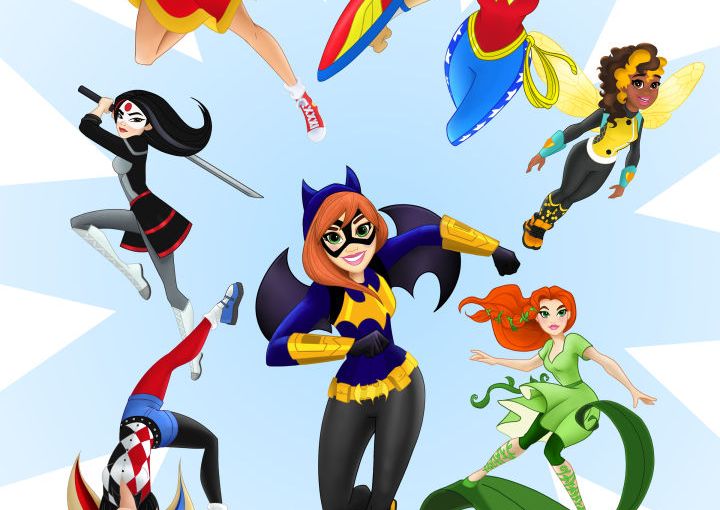
As the geek dad of a little girl, trying desperately to introduce her to alternatives to Disney Princesses and the like, I know how difficult it is to find appropriate content and merchandise featuring female superheroes, so when I first read about this I was excited. It features teenage versions (hence justifying the ‘girls’ tag) of Wonder Woman, Supergirl, and Batgirl (who were in my Top Five Awesome Alternatives to Disney Princesses). The likes of Harley Quinn, Bumble Bee, Poison Ivy, and Katana will also be involved. The target audience is girls age 6-12.
Finally, we have a big media corporation acknowledging what we keep banging on about – that there is an untapped market of girls who love superheroes. Glancing at the artwork, I thought how refreshing to see a group of female characters for girls in dynamic action poses, rather than the passive imagery that usually adorns apparel and accessories in the ‘pink’ aisle.
But taking a closer look at the artwork, I started to have some doubts. I realised that they all look like generic Disney Princess clones, which potentially alludes to the marketing intentions of those involved – going after Disney’s share of the girls merchandise market. If they do this by offering superhero culture as a real alternative to princess culture, that would be great. But if they take these superheroes too far in the direction of Disney’s heroines, it will be little more than a cynical market grab than trying to create a different offering. There are also issues of body image – while superheroes have always been visually hyper-realistic there’s a big difference between males having big abs and girls having waists smaller than their heads.
Then there’s the idea that this is being “designed just for girls”. It’s important to Include boys in anything involving female superheroes, so they understand from an early age that this genre is for girls too. I still read of boys telling girls that they can’t be into superheroes/Star Wars, only boys can. Subdividing the genre to create a girls only space clearly doesn’t promote inclusion.
The involvement of Barbie manufacturer Mattel is another worrying sign. While it’s worth noting they’ve said they’re making “action figures”, not dolls, this is the company that has presented a narrow view of femininity with Barbie for decades. If you want to see the kind of female superhero THEY think little girls want to play with, look no further than their recent Barbie superhero Super Sparkle, a pink and glittery princess who gets super powers from being kissed by a magical butterfly.
You can bet Mattel have noticed that Wonder Woman, as well as being a superhero, is also a princess.
There’s also the mention of LEGO, and “their experience and success engaging girls”. This can only be alluding to their LEGO Friends brand, the popular but divisive line of LEGO for girls, a pink and pastel gender ghetto that exists away from the rest of LEGO’s creative construction toys. A dedicated girls LEGO implicitly defines the rest of to as for boys. I worry the same thing could happen here. And that they’ll make a superhero spa playset.
And finally, they’re not even superheroes! They’re called ‘Super Hero Girls’ not ‘Superhero Girls’. The cynic in me suspects the thinking is that superheroes are for boys, but these ‘super heroes’ are for girls.
Am I being overly pessimistic? Probably. I would love this to be awesome. In a time when female superhero characters such as Black Widow, Gamora, and Big Hero 6’s Go-Go and Honey Lemon are routinely removed from merchandise, a new female superhero range is great. There’s no way they can ignore the female characters when they’re ALL female! So we should get a viable alternative to the pink & pastel shimmer & sparkle female characters of the moment. I hope that the cartoons, books, and comics provides wonderful character led tales of action, adventure, and inspiration with a diverse range of female superheroes (and villains). The lead writer of the project is a woman, Shea Fontana, so we’re not simply getting a male idea of what they think little girls like.
But ultimately, the reason I want my daughter to be exposed to female superheroes is to offer her an alternative to the current mass market merchandise targeted to girls. If DC Super Hero Girls is simply a cynical way to combine aspects of Disney Princesses and Barbie in order to get a piece of the existing ‘girl’ market, then it’s no real alternative at all.
=====
I’d love to know what you think about this ‘DC Super Hero Girls’ line.
PRESS RELEASE: A New Super Hero Universe Designed Just For Girls
Mattel to Launch Company’s First Action Figures for Girls
Unprecedented Initiative to Include Digital Content, TV Specials, Made-For-Videos,
Publishing, Toys, Apparel and Other Products
Random House Children’s Books to be Master Publishing Partner
The LEGO Group to be Exclusive Construction Partner
Beginning in Fall 2015, DC Entertainment, Warner Bros. Animation, Warner Bros. Consumer Products and Mattel join forces to launch DC Super Hero Girls, an exciting new universe of Super Heroic storytelling that helps build character and confidence, and empowers girls to discover their true potential. Featuring DC Comics’ most powerful and diverse line-up of female characters as relatable teens, DC Super Hero Girls will play out across multiple entertainment content platforms and product categories to create an immersive world.
Developed for girls aged 6-12, DC Super Hero Girls centers on the female Super Heroes and Super-Villains of the DC Comics universe during their formative years—prior to discovering their full super power potential. Featuring a completely new artistic style and aesthetic, DC Comics’ icons such as Wonder Woman, Supergirl, Batgirl, Harley Quinn, Bumble Bee, Poison Ivy, Katana and many more make their unprecedented teenaged introduction. Each character has her own storyline that explores what teen life is like as a Super Hero, including discovering her unique abilities, nurturing her remarkable powers and mastering the fundamentals of being a hero.
“DC Entertainment is home to the most iconic and well-known Super Heroes including Wonder Woman, Supergirl and Batgirl,” said Diane Nelson, President of DC Entertainment. “DC Super Hero Girls represents the embodiment of our long-term strategy to harness the power of our diverse female characters. I am so pleased that we are able to offer relatable and strong role models in a unique way, just for girls.”
The initial launch of DC Super Hero Girls in Fall 2015 will include an immersive digital experience, original digital content and digital publishing—providing opportunities for girls to interact with characters, learn about the storylines, and engage in customizable play. TV specials, made-for-videos, toys, apparel, books and other product categories will begin to rollout in 2016.
“Developing a Super Hero franchise exclusively for girls that includes all of the key components of a comprehensive entertainment experience—from content to consumer products—is something we are excited to be doing in conjunction with our great partners,” said Brad Globe, President of Warner Bros. Consumer Products. “It’s really an honor to be part of this cultural moment and to be delivering a concept so rooted in a relatable and empowered theme that the characters of DC Comics are uniquely able to present.”
As master toy licensee, Mattel is collaborating with DC Entertainment, Warner Bros. Animation and Warner Bros. Consumer Products on DC Super Hero Girls’ narrative creation, interactive digital activations and ultimately a toy line launching in 2016. Mattel category-leading firsts include a line of characters for the action figure category, an area of the industry that has been primarily developed with boys in mind, and fashion dolls featuring strong, athletic bodies that stand on their own in heroic poses.
“Partnering with the best and being the best partner is of paramount importance,” said Richard Dickson, President, Chief Operating Officer, Mattel. “Together with Warner Bros. and DC Entertainment, the DC Super Hero Girls franchise will further expand our already powerful girls portfolio. We know Super Hero is a culturally relevant theme and the DC Super Hero Girls franchise will engage and inspire girls, providing cues to explore heroic acts through play and into real life.”
The Random House Books for Young Readers imprint of Random House Children’s Books has been appointed the master publishing partner for the franchise and will be creating a portfolio of books that will bring the DC Super Hero Girls world to life, beginning in Spring 2016. Random House’s publishing program will be complemented by a series of original graphic novels from DC Entertainment. The LEGO Group will also be key to building the DC Super Hero Girls franchise, leveraging their experience and success engaging girls in creative construction play to bolster this universe through an array of LEGO® building sets designed to inspire girls’ imaginations. Additionally, consumer products partners around the world will be engaged in creating a merchandise line dedicated to DC Super Hero Girls across all key categories.
Making play dough with this recipe is so easy even I could do it!
Making playdough (Play-Doh) is so easy that you need never buy the Hasbro stuff again.
This is an uncooked playdough recipe, but does use freshly boiled water so probably best not to involve the kids in making it – at least with the boiling water bit! While there are plenty of recipes out there that are more child-helper friendly, this is the one that’s worked best for us in terms of the finished result.
You’ll probably have most of the ingredients in your store cupboard, though the hefty amount of salt required may exceed your usual cooking requirements in this sodium reduced age.
This stuff keeps kids amused for HOURS at a time, so get in the kitchen and whip some up quick!
How to Make Playdough (recipe)
Ingredients
280g flour
30ml (2 tbsp) vegetable oil
175g salt
2 tbsp (25g) cream of tartar
350-400 ml boiling water (added gradually)
food colouring (40ml bottle)
few drops of glycerine
Mix the flour, salt, cream of tartar and oil in a large mixing bowl
Add food colouring TO the boiling water then into the dry ingredients
Stir continuously until it becomes a sticky, combined dough
Add the glycerine (optional, but recommended)
Allow it to cool down then take it out of the bowl and knead it vigorously for a couple of minutes until all of the stickiness has gone (This is the most important part of the process, so keep at it until it’s the perfect consistency!)
If it remains a little sticky then add a touch more flour until just right
If you’re raising a girl, there’s no escaping the reign of princesses over their generation – especially Disney Princesses. Frozen’s Anna and Elsa have only strengthened the power that the princess industrial complex wields over their developing cultural lives. If you’re tired of all the trappings of princess culture cluttering up your little girl’s childhood, or just wish to expose them to alternative female led films, TV, books, and toys – here are my top five awesome alternatives to Disney Princesses to inspire and empower your little girls.
The animated films of Studio Ghibli, and Hayo Miyazaki in particular, should be a part of everyone’s cinematic childhood. My Neighbour Totoro, Kiki’s Delivery Service, and Whisper of the Heart are particular favourites of ours and they boast a wonderful range of female characters, any one of whom is a great Disney Princess alternative. Scarcely a day goes by without my daughter requesting to see at least one of them. Totoro centres on the gentle adventures of two young sisters in fifties Japan and their encounters with kind hearted forest spirits; Kiki is an entrepreneurial 13-year-old witch who leaves home and earns a living by starting the small courier business of the title; Whisper of the Heart also features a teenage girl, who is an aspiring writer seeking inspiration. I have seen them all more times than I could possibly count, and I still find them moving, inspiring, and utterly delightful. There is plenty official and unofficial merchandise around. We picked up some Totoro soft toys when we passed through Japan a few years back, and bought the 3yo a much loved Kiki dress up for Christmas. For other movies, also check out Miyazaki’s pre-Studio Ghibli Nausicaä of the Valley of the Wind for a wonderful female led eco-adventure, Ponyo for younger kids, and Spirited Away and Princess Mononoke for older ones who can take more intense scenarios. But perhaps save Grave of the Fireflies for another time – it’s possibly one of the saddest films ever made.
One of the few female superheroes that non-comic fans know about, Wonder Woman remains a pop cultural feminist icon and an awesome Disney Princess alternative. Conceived in the forties by American psychologist William Moulton Marston, he wanted to “create a feminine character with all the strength of Superman plus all the allure of a good and beautiful woman”. Hmm. Anyway, Wonder Woman is a warrior, and – yes – a PRINCESS, but she refuses to let being a princess define her, and it’s something she successfully rebelled against in her very first appearance. The character’s continued fame goes back to the fondly remembered seventies TV show starring Lynda Carter. The show tied into the popular feminism of the decade, typified by the likes of Gloria Steinham – who had previously launched Ms. Magazine in 1972, with none other than Wonder Woman on the cover. ‘Retro’ Wonder Woman imagery continues to adorn all manner of merchandise today, and this iconic cartoon look is as visually appealing as any Disney Princess. There is a LOT of merchandise out there if you hunt for it, but be warned – it’s far easier to get hold of a Wonder Woman t-shirt for a woman than a little girl. In addition to Wonder Woman, also be on the lookout for Batgirl and Supergirl gear. DC licensees are much better than Marvel in creating merchandise with their female heroes. It’s time to “Woman Up” Marvel.
3. The Wizard of Oz
3yo daughter in her Dorothy outfit
While Frank L. Baum’s original book has been eclipsed by the colourful 1939 movie, both feature the engaging Dorothy Gale and her adventures in Oz with her three male sidekicks. While the film is wonderful, Dorothy is certainly more proactive and determined in the book, for instance not relying on her male friends to rescue her from the Wicked Witch but rescuing them instead. However she is an appealing character in both, with an iconic eye catching look that makes a nice change from glittery pastel dresses – and because the book has been out of copyright for a long time there are lots of affordable merchandise out there, ranging from dress up outfits to apps. Perhaps start with one of the books adapted for first readers, or of course there’s the wonderful film – the technicolour reveal of merry old land of Oz still remains one of the great moments of Hollywood magic, that will leave your little one on awe.
4. Katie Morag
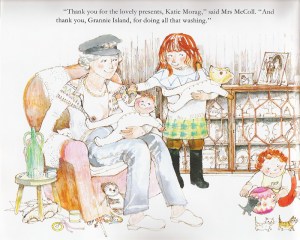
From ‘Katie Morag and the Tiresome Ted’ by Mairi Hedderwick, published by Red Fox Picture Books
Set on the fictional Isle of Struay, off the west coast of Scotland, this series of books (and now a TV series) feature the independently minded little girl Katie Morag. Wonderfully written and beautifully illustrated by Mairi Hedderwick, the stories see our young red-headed hero in her trademark white jumper, green tartan skirt, and wellies, on her everyday adventures involving her family and fellow islanders. The spirited Katie is a great role model for little girls – our 3yo daughter has been inspired by this Scottish girl to be more independent herself. The books offer lots of other great female role models too, from her mother who runs the Post Office while also breastfeeding her new baby, to ‘Grannie Island’, Katie’s no-nonsense dungaree wearing, tractor driving grandmother. I really enjoy both reading these to my daughter and watching the TV show with her.
5. Star Wars
From ‘LEGOS Gir Problem’ published on ‘From Bricks To Bothans’
The galaxy far, far away is just as much a place for girls as boys – it just hasn’t been marketed that way since a long time ago. Top of the list of great female characters (showing my aged bias) is Leia, who is a great Disney Princess alternative. A royal in name only, she is a rebel fighter, political leader, and social activist. She is a central character in the Star Wars universe and there is a ton of merchandise out there – HOWEVER, there isn’t much new stuff at all. Despite Disney buying Star Wars, and churning out all kinds of new Star Wars goodies, don’t go to a Disney Store expecting to find anything with Leia on it, and there isn’t anything. If that bothers you, please read more here, and complain to them here about that. For other more recent characters, check out Padme/Amidala from the prequels and TheClone Wars cartoon, Ahsoka Tano also from the Clone Wars, or Sabine & Hera from the new Star Wars Rebels animated TV series. These are great empowered women for any child to look up to, and a terrific way into Star Wars and the wider area of sci-fi for little girls. Geek culture is synonymous with the STEM worlds of our children’s future, so if we don’t want to lose vast swathes of the next generation of world builders – because they’re girls who think this is boys stuff – then get them some Star Wars toys. You may even have some in your parents attic. 🙂
=====
What do you think about this list of alternatives to Disney Princesses?
What about the princesses themselves? Are they harmful or harmless? I’d love to read about any additions you have to this (short!) list, or why you think Disney Princesses are fine. Please comment below, join the conversation on the Facebook page, or on Twitter @manvspink.
“Girls Rule!” t-shirt, featuring Supergirl, Wonder Woman, and Batgirl. (Photo courtesy of @UKToyCollector)
Supergirl, Wonder Woman, and Batgirl all on the same kids t-shirt. As a geek dad it’s the kind of item I’m always on the lookout for. I don’t even mind (too much) that it’s pink. What’s troubling is the slogan, “Girls Rule!”. Because “Girls” don’t rule at all.
It’s a phrase synonymous with “Girl Power”, which probably has its origins in the Riot Grrrl feminist punk movement of the 90’s. While the progressive message of “Grrrl Power” was diluted when transformed into the safe and snappy commercial slogan “Girl Power” for 90’s pop phenomenon the Spice Girls, at least that version introduced many children to the notion of girl empowerment. However, the band also popularised the far more problematic “Girls Rule!”.
The girls who were fans of the band in the 90’s are now women in their twenties and thirties. What kind of world have they grown up in? Is it one where “Girls Rule”? The gender pay gap remains entrenched, and in the UK is even widening. Only 30% of science, technology, engineering and mathematics (STEM) graduates in the UK are women, and just 17% of all professors in STEM are female. Both houses of UK parliament have only 23% women.
A slogan like “Girls Rule” seems little more than a lie in this context. It implies that women leaders are respected, listened to, and rewarded for their hard work, talent, and intelligence – when that is clearly not the case. Perhaps the slogan “Girls Rule!” was created as a way of hiding the sad reality of gender inequality.
The empowering messages we convey to our children are important, but they can easily backfire. As American comedian Sarah Silverman wryly observed, “Don’t tell girls they can be anything they want when they grow up. Because it would have never occurred to them that they couldn’t.”
This week new research on marketing to girls, found that when “…girls hit the age of 13 they start to feel less confident and more worried about the world around them.” The reasons are unclear, but this would also be the time they experience the dawning revelation that the reality of being a woman, on the wrong side of the gender bias divide, isn’t quite how they imagined it would be when they were little girls.
Advertisers obviously know the power of a good slogan, and a source for a new girl empowerment one has come from an unlikely place. Always (makers of ‘feminine hygiene products’) found through their market research the same issue of girls suffering a significant drop in self-confidence around the time they hit puberty.
The company tried to address these feelings for an ad campaign, and a new slogan entered the girl empowerment lexicon – #LikeAGirl. They deftly took the former playground insult, and transformed it into plaudit. When you run like a girl, throw like a girl, fight like a girl – you are not doing it badly, you’re doing it incredibly. At least that’s the shift in meaning hoped for.
The fantasy of “Girls Rule!” seems tepid next to the optimistic reality of doing amazing things ‘like a girl’.
All I need now is to get THAT on a kid’s female superhero t-shirt.
I’m not going to pretend to my daughter that she’s growing up in a world where “Girls Rule”. She will have many challenges to face in life, and lying to her about them won’t help her deal with them.
But I’m buying Asda’s “Girls Rule!” t-shirt for her. Three awesome female superheroes, drawn in the classic retro style, on a kid’s sized top in the UK? Sold. I also want Asda to know that female superheroes sell too.
And my daughter can’t read. Yet.
What do you think about the slogan “Girls Rule”? Helpful, harmful or neither? Please discuss by commenting below, joining the conversation on the Facebook page, or on Twitter @manvspink.
‘Working Mom’ by Ran Zwigenberg. Photo used under CC license
Whenever there’s coverage of mothers in the workplace, it’s never long before the topic of how they cope with the competing needs of their children and their job comes up. What’s wrong with this? It’s a narrative that’s only ever applied to working mothers, and rarely – if ever – working fathers.
On the BBC series Inside the House of Commons this week, one of the featured MPs was a busy mum who juggles the demands of her job with the needs of her family. As the listings described the scenario: “Lib Dem MP Jenny Willott… seeks to balance new parenthood with politics.”
I am not denying Ms. Willott’s very real struggle between being a parent and an MP (and Deputy Chief Whip), but yet again, the search for this ‘balance’ was presented as an issue only for the working mother. While we did see the involvement of her partner, where was the male MP also struggling in the same way, having family dinners in his parliament office, dropping off his children at the House of Commons nursery, or leaving his crying child with an aide so he can dash off to the house for an important vote? Maybe he doesn’t exist. Maybe society’s expectations of working mothers are different from those of working fathers.
This was yet another example that feeds into the myth that when a mother is working, childcare is her responsibility. That the need for flexibility is the preserve of the working mother, not the father. That mothers struggle to maintain a work/life balance in a way that fathers don’t.
This week there was a report about the rising costs of childcare in the UK, which is indeed a big problem for parents. Yet I kept reading how this was an issue for working mothers or mothers returning to the workplace, never about fathers.
My wife has a full time job, and I freelance as well as being home with our daughter. In any discussions I enter into about work, the cost of childcare up at the top of the list when determining the feasibility of me taking on the job. The issues around flexible hours and an understanding that I may have to be absent when my child is sick are also important for my employer to know, because I am the primary caregiver to our daughter.
Why We Need to Stop Talking About Working Mothers
I don’t understand why are we always framing any discussion about childcare, flexible working, balancing the demands of home and work, with ‘Working Mothers’. These issues are not exclusive to mothers – they are parenting issues.
As a father, I find it depressing that people think dads don’t care this much about their children, that we too don’t lament the lost hours we could be spending with them when working. But as a parent of a daughter, I find the sexism of this prevailing attitude towards women in the workplace far more depressing.
It’s an attitude that is especially toxic when there are employers that would prefer not hire a mother, because they think that it’ll be too much hassle. It’s an attitude that fathers rarely encounter.
I am not seeking to diminish the emotional stress and logistical hassle of being a working mother. Despite not being a mother, I understand it completely.
I just think we need to stop talking about working mothers, and start talking about working parents instead. These are issues that affect us all and problems for us all to deal with.
What do you think about the way working mothers are perceived? Is being a working mother different than being a working father? Please get involved by commenting below, joining the conversation on the Facebook page, or on Twitter @manvspink.
Can we just agree that a little girl giving her daddy a Valentine’s card is a bit creepy.
This week playgroups, preschools, and nurseries across the globe were having their usual themed crafts, which in all likelihood involved making Valentine’s Day cards. I didn’t think much of it. I figured these cards would be given to the parent who wasn’t there, from their partner that was.
Contrary to my assumption, at the playgroups I went to, many children (well, only girls) were being encouraged by mothers to make cards for their fathers. The thought of getting a Valentine’s Day card from my daughter makes my skin crawl.
Valentine’s Day is one of two things. It is either a cynical marketing opportunity to sell themed cards, chocolates, lingerie, and even ready meals (‘Give your Valentine a night off cooking with a special Macaroni Cheese’). Or it’s a day to celebrate love with your partner, a partner to be, or just a good old fashioned secret admirer.
Valentine’s Day is a time for lovers, and a time for retailers to exploit that love. It is not a time for parents and children to express their very different love for each other.
While there is an argument against children ‘celebrating’ Valentine’s Day, because it’s asking them to grow up too soon, it’s also true the role playing adult scenarios is an important part of our children’s development. The desire for a partner, who is more than a friend, is an important concept for them to understand. It’s how they came to be after all.
I also remember getting cards as a child from secret admirers who I still have no idea about. It almost remains my purest experience of the day. Who’s heart wouldn’t be sent aflutter with a note from a secret admirer? Valentine’s Day is a day for love, but romantic love, which is to say that heady, intoxicating combination of love and desire.
“Valentine’s Day is a time for lovers”
Remember the song Somethin’ Stupid? It’s a catchy duet about someone lamenting their missed opportunity of getting a date into bed by saying Somethin’ Stupid’ (Like I Love You). If you’re younger than me, perhaps you know the Robbie Williams & Nicole Kidman version. That was a fun rendition of a cute song.
However, it’s more famous for it’s frankly creepy version, which was a duet between Frank Sinatra and his daughter Nancy.
Have a listen.
It’s also fairly creepy when sung by Nancy Sinatra and her brother, Frank jr. Take a look.
It’s really NOT cute to have a father and daughter, or brother and sister, pretending to sing about a sexual attraction to each other. It’s gross. That’s why this song referred to as The Incest Song.
Let’s not teach our children that our love for them is the same as our love for our partners. It’s not better, not lesser. Just different. And they need to learn the difference.
What do you think about getting a Valentine’s Day card from your child? Cute? Or creepy? Please comment below, join the conversation on my Facebook page, or tweet me @manvspink.
A Labour government will double paternity leave for dads from two to four weeks, and increase their weekly paternity pay to £260 – over £100 more than present. No doubt this move will be tagged as anti-business by Labour’s opponents. But is it as pro-family as it seems?
I was lucky that I spent the first 6 weeks home with my daughter. I can’t imagine not having spent that time with her, and I feel for other fathers who wanted the same but weren’t able to.
While this Labour policy may seem progressive, reflecting the reality that many fathers want to be at home with their newborn too, I feel what it’s really reinforcing is that after 4 weeks a man’s place is still at work while a woman’s is at home with the baby.
There are many reasons why fathers decide to become stay-at-home dads. In our case is was a combination of me really wanting to be home with our daughter; my wife’s desire to return to work and maintain her career; and a feeling that I might be better suited to being home all the time with an insatiable grub that lacks basic conversation skills. The fact that my wife also earned more than twice as much as me was not an obvious influence, but perhaps it made our decision easier.
What I think families need more than a simple increase in paternity pay and entitlement, is support to make these type of flexible decisions that are right for them, for there is no one size fits all way of parenting any more. While for some couples the mother being home full-time is what’s wanted, others (like us) would prefer have the dad home in those early years. Many couples would like to both be working as soon as possible. The financial hit would be harder on some rather than others, so that too would affect decisions.
Far more progressive is the Shared Parental Leave system that comes into force from April, where parents can share the majority of the mother’s 52 week leave entitlement between them, in theory letting the couple decide which one of them is to become the primary carer. One of the biggest stumbling blocks with this is that many women have generous maternity packages from their employer that are far in excess of the Statutory Shared Parental Pay of £138 per week.
I remain unconvinced about Labour’s proposal, though I am sure it will lead to more fathers taking time off to be with their newborn. The IPPR, who came up with these proposals, believe take up will increase from 55% to 70%. That sounds optimistic, but I guess we’ll see should we have a Labour government come May.
I believe that the level of pay is really a small part of the reason for the low numbers taking paternity leave. For parents who had no interest in the father being home, their feelings will remain unchanged. Many men feel that their employer would look unfavourably on them taking leave, that their job cannot be interrupted, or that it will hurt their career. They too will remain feeling the same way about paternity leave.
The policy seems rather outdated next to Shared Parental Leave in that it assumes the father will return to work after 4 weeks while the mother is home with the baby. If Labour really wanted to encourage more men to become stay-at-home dads, or women to become working mothers, then I think they should really be building upon the Shared Parental Leave system, perhaps finding a way for mums and dads to share an employers parental leave system.
So is Labour really trying to be progressive? I am reminded of the free childcare/early education for three year olds. The 15 hours of free childcare per week, notionally intended to encourage at-home parents back to work is now seen as more of a rebate to middle class families. They would be paying for the childcare at nurseries anyway but now get a term time fee reduction. I have a similar feeling about these proposals, that it’s intended to be a nice little financial present for those families who would have probably used paternity leave anyway.
This feels less about a policy helping families, than a headline to help persuade disaffected supporters to vote Labour in May. But at least a few more dads will get to spend time with their newborn like I did.
What do you think about these paternity leave proposals? Please get involved by commenting below, joining the conversation on the Facebook page, or on Twitter @manvspink.






 Man vs. Pink