I took my daughter to preschool earlier this morning. We’ve been explaining to her what it is for a while. How it’s like playgroup but without daddies & mummies. That a few of her friends will be there. And how daddy will take her, play for a little bit, go away for a bit, and then come back to take her home. She seemed ok with it. All went as expected. Especially the ‘go away bit’ unfortunately.
10 mins after arriving, I gently backed away as she was occupied at the play-doh table, one of her favourite activities.
I watched from the kitchen. She was happily for a while, but then I could see it developing. The play-doh squishing slowed. Her head began to glance around. The lower lip began to quiver. Then the tears began to flow. Not sad tears, but utterly inconsolable distraught tears, with the barely discernible cries of “Daddy! I want my daddy!”.
I exchanged looks with her key worker, who indicated I should hang back while she tried to placate my daughter with a story. But it was to no avail, so she brought my daughter over to me.
My daughter held me tighter than she ever has, repeating over and over through the stream of tears “Daddy! I love my daddy!”. It was a scene reminiscent of the ending of ‘The Railway Children’.
Except, in this case the ‘Daddy’ (me) then abandoned said daughter when she was distracted by the outdoor play, as it was decided this was for the best in helping her adjust, but they would call me if she got too upset and couldn’t be calmed down.
So here I am at home, with a cup of tea and a bacon sandwich for emotional comfort, staring at the phone hoping it doesn’t ring.
The 2 1/2 hour preschool session, that I thought wouldn’t be long enough to get much done, now seems to be lasting an eternity.
Linguine al gamberi (aka shrimp or prawn linguine with chilli)
Whether you call this crustacean a shrimp or a prawn, what we can all agree on is that you must – if at all possible – make a stock with the heads & shells. I first had this seafood pasta dish on honeymoon on the Italian island of Ponza, a favourite Mediterranean getaway for Romans seeking respite from the capital’s summer inferno. Delicious Italian seafood dishes top the menus of eateries across the island. What ensures that this seemingly simple dish evokes the sea is the rich prawn stock, layered with the other flavours, all unified at the end by finishing the linguine in the seafood sauce. For an extra sumptuous seafood pasta dish use butter as well as oil to make the stock, and add a glug of wine when simmering tomatoes. You could also sieve the tomatoes before cooking for a smoother texture. I have been generous with the serving size. The depth of flavour is incredibly moreish, so you should make plenty. It’s also advisable to have some nice bread on standby. However full you may be, you will likely still feel an overwhelming need to mop up any excess sauce.
Linguine al gamberi recipe
Serves 4INGREDIENTS:
500g linguine
800g large raw prawns/shrimp, shelled & deveined (retain heads & shells for stock)
1 shallot, finely chopped
1-6 cloves garlic, finely chopped (adjust to taste)
1-2 chillies, deseeded and finely chopped (adjust to taste)
500g sweet cherry tomatoes, quartered
Stock (see below)
Juice & zest of 2 lemons
Large handful flat leaf parsley, finely chopped
Olive oil
Salt & pepper
Glass white wine (optional)
Stock
Olive oil
Prawn heads & shells
Large glass white wine
250 ml water
Salt & pepper
50g butter (optional)
METHOD:
In a large saucepan on a medium heat, fry prawn heads & shells in generous glug of olive oil. When pink, add white wine. After a few minutes when alcohol has evaporated, add equal amount of water and simmer for approx 10 minutes. Crush heads & shells while cooking to release as much flavour as possible. Top up water if necessary, and season to taste. Strain and retain stock.
In a large wide bottomed pan, fry shallot on a medium heat. After 5 minutes, add garlic & chilli and cook for a few more minutes. Add tomatoes and gently simmer for at least 15 minutes, gradually adding strained stock.
Cook linguine in salted water (allegedly should be as salty as the Mediterranean) to about a minute or 2 less than packet instructions. If sauce gets too thick during pasta cooking, add some of the linguine water, tbsp at a time. Retain a cup of water before draining for same reason.
Add prawns to sauce – for larger prawns cook for couple of minutes.
Drain and stir in the linguine, add lemon zest, season to taste, and cook for further couple of minutes until pasta is al dente. Loosen sauce with some retained pasta water if necessary.
Stir in lemon juice and remove from heat. Cover and leave for five minutes. Pasta will absorb even more flavour from the sauce, but without cooking further.
Add parsley, and serve the sumptuous seafood pasta in warmed pasta bowls.
LEGO’s new Fusion line may meld real & digital worlds, but it still divides our boys & girls.
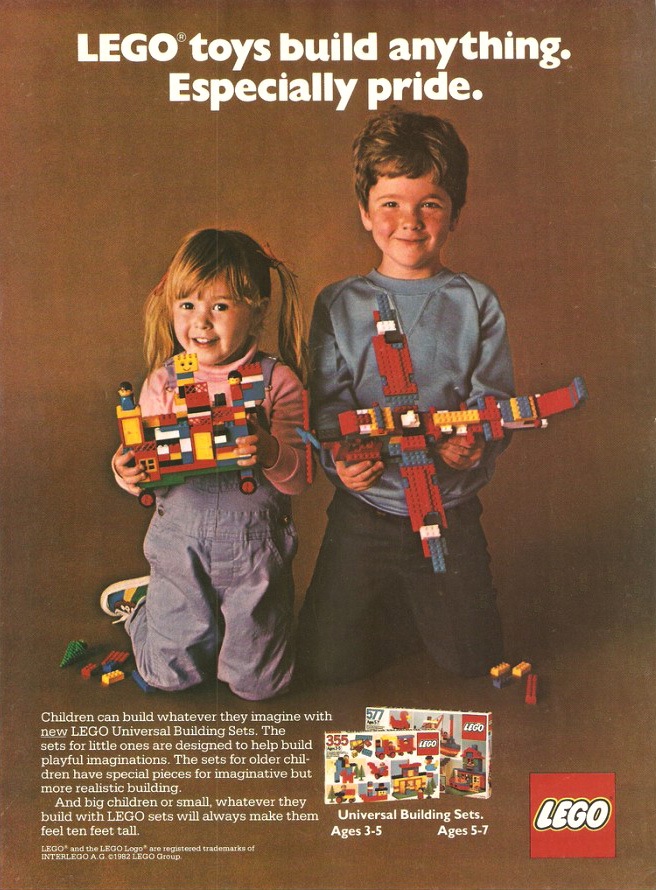
A LEGO ‘Universal Building Set’ ad from 1982, depicting a boy and girl playing together with the same LEGO. Crazy.
I had high hopes when I was alerted to ‘LEGO Fusion’. It was the word ‘fusion’, the combining of two distinct entities into one, that piqued my interest.
LEGO have rightly had a lot of flack for creating and marketing their product separately to boys and girls in recent years, especially given their history of previously being a universal toy. So would this new fusion line finally reunify the divided markets and be aimed at both?
The word fusion also brings to mind various scientific processes and ideas, most notably nuclear fusion. Could this be a line linked specifically to STEM fields, in which female inclusion and engagement remains an ongoing issue.
Don’t be silly.
Turns out the ‘fusion’ aspect is the connection of physical building with virtual construction, in the form of smartphone & tablet apps and associated physical sets. The virtual aspect appears to be inspired partly by The Sims and Civilisation – but mostly by Minecraft, the open world virtual brick building phenomenon. LEGO have stated that they wish they had invented Minecraft. In fact, it was created by a games designer from the Danish toymaker’s Nordic neighbour Sweden. Minecraft also has a large number of female enthusiasts (though evidence suggests they may often not admit to being female, given how women are often treated in online & gaming circles – but that’s another issue!).
So LEGO Fusion may not be the revolutionary science based line I imagined (I actually have no idea what that could be, but I was waiting to be dazzled), but still – it’s an innovation for the company to move its core product – bricks – into virtual space. Good for them. And it’s a concept clearly able to be enjoyed by boys and girls.
But then I saw this promotional video for it. It effectively conveys the blending of virtual and actual space, focusing on a child exploring the worlds that the line consists of.
First there’s Town Master, where you get to be a town planner/ruler. That’s followed by Battle Towers, a virtual war space where your constructed ‘Battle Tower’ has to fend off an enemy invasion. Then there’s Create & Race, where you build cars and race them. As ideas, they all look and sound pretty cool. But, there’s something important missing from the marketing hyperbole. Girls.
And then it happens.
Two girls are shown playing on the other side of the table from the boy. What are they doing – planning a town? Creating a battle tower? Engineering their own race car?
Nope.
The girls have their own app and set, within the gender ghetto of the LEGO Friends line. And what do the girls get to create in their fusion space? Their line is called Resort Designer, and they have to create… a dream beach resort.
In LEGO Fusion, boys build towns and engineer machines, while girls get to build… a resort
So rather than fusion, we have division & limitation. Physicist, oceanographer and broadcaster Dr. Helen Czerski memorably responded on Twitter to the LEGO Fusion ad with “Ick”.
Dr. Czerski continued “Obviously, all girls are interested in is holiday resorts, while boys get on with building our cities.”
The whole reason advertising exists is that it works. If it can persuade us to part with our cash for a product, then it stands to reason that the reality it depicts is also convincing.
There’s nothing stopping you – or I – from countering these messages ourselves to our kids, but we’ll never be able to fend them off entirely. The seed will be planted, that will potentially grow into deep rooted conviction that may see a girl choosing very early on in life not to embark on a life in science, technology, engineering or manufacturing, and may lead to an adult male choosing not employ a woman in one of these fields, because from childhood, without even realising it, they have learned that these areas are inherently male.
I don’t think LEGO is evil, that it is trying to socially engineer a world where women are directed to a pastel coloured inconsequential cul-de-sac while the men take care of the important stuff. They’re just trying to sell their plastic bricks. But doing it by entrenching gender segregation, and limiting the life choices of our girls, is simply wrong. I can’t say it plainer than that.
Imagine, if instead of gender, LEGO based their marketing around race. Imagine if the Fusion ads showed white people (as they do) playing with the Town, Racing, and Battle lines – and then depicted stereotyped minorities in and using sets based on sports, hospitality, or a factory? Imagine if they produced market research that showed that this was what the minorities in question wanted. That they were just supplying demand. It would rightly be labelled as racism.
Oh god, I do hope I haven’t given them a new marketing angle to try out…
Back in the real world, my daughter will continue to play with her hand-me-down LEGO, that hails from the time when it was a universal toy. And maybe when LEGO pulls back on the gender based madness, we’ll hand over some real money for new LEGO.
As long as it remains backwards compatible with the concept of universal building.
============
The sold out, universally acclaimed, LEGO Ideas Research Institute. Hopefully not the last you’ll see of it.
One set I would have parted cash with was their much heralded Female Scientist set.
In a bad month of gender news for LEGO, they also revealed that this set, which I didn’t even get a chance to buy, is in fact a limited edition.
Currently sold out, while LEGO have said they are going to release more stock, there is no indication that this means they will actually manufacture any more.
If you – like me – think this obviously popular set should be mass produced, then please sign this petition created by Melissa Atkins Wardy (Author of “Redefining Girly”, owner of Pigtail Pals & Ballcap Buddies).
Apparently, a new LEGO design must achieve sales of £106,000 to break even. At £15.99 a pop, this set needs to sell about 6,600 units – so the petition needs to reach at least that figure to show there’s a viable market for it (though the fact it achieved 10,000 public votes to get made in the first place should be enough!).
It seems a lot of us stay-at-home dads don’t like the term ‘Mr. Mom’ being applied to us. Well, when I say us, I don’t mean me – I’m fine with it. In fact, I encourage it.
I have fond memories of Mr. Mom, and I have no reason to believe it to be significantly better or worse than its 80’s comedic peers, such as Police Academy, Bachelor Party, and Stripes.
I read a nice piece by Nicole Shanklin called ‘Modern Parenting: Mr. Mom Style‘. Her husband was a stay-at-home dad to their daughter for 2 1/2 years. Lots of fellow (blogging) dads while complimentary about the post were less so about the inclusion of ‘Mr. Mom’ in the title (check the comments). So much so that it was changed to ‘Modern Parenting: Stay @ Home Dads Rock‘, which I think is a shame.
What are the arguments against calling a stay-at-home dad ‘Mr. Mom’?
Well, fairly valid ones: Working mothers are not called ‘Ms. Dad’; being a stay-at-home dad doesn’t make you a male mother; what’s wrong with just calling us dads?
And yet… When I became a stay-at-home dad in 2012, I relished the moniker of ‘Mr. Mom’, and I still do. While stay-at-home dad is a fair description of my role, as is the shorter at-home dad, they lack the wordplay of Mr. Mom, and honestly – they simply fail to conjure up that image of Michael Keaton holding up his baby’s bottom to a hand-dryer.
Perhaps this is a clue to why I like the term. Keaton’s expression in that image exudes confidence. Many stay-at-home dads will tell you of being judged – often borne out through experience – about our ability as primary caregiver, because we are dads. That we are perceived as less able parents because we are men, that our ‘male’ methods are inferior to ‘female’ ones – which from memory is also a theme of the movie.
Parenting Mr. Mom style
In some aspects, I do parent differently from my wife. Not better or worse, just different. Is this because we are male and female? I have no idea. My daughter wears a lot of superhero t-shirts, knew more Star Wars characters at age 2 than my wife does at age [REDACTED], and will respond to food made with scotch bonnet chillies with an enthusiastic ‘More!’. Have I introduced these things to her because I am a man? I’m sure all the chilli loving fangirl mothers out there would disagree with that notion (you know who you are…).
But for me, to feel confident about my way of parenting & to introduce my daughter to things I am passionate about is fundamentally important. I don’t want to second guess myself and be consumed with self doubt about whether this is really the right or wrong thing to do – or even worse, to change my behaviour because I am worried about how others might judge me. Is drying a baby’s bum on a hand-dryer unorthodox? Sure. But that doesn’t mean it’s the wrong thing to do (although I’m not advocating it).
So I like to channel the Mr. Mom in that poster, the confident dad parenting his way.
Perhaps the main reason that I don’t have a problem with it is this: I’m English. We don’t use the word ‘Mom’ – it’s ‘Mum’. To us, ‘Mom’ is basically an exotic word from a foreign culture, so when someone calls me ‘Mr. Mom’ (which people do) I simply think of Michael Keaton in that poster. It’s a pop culture reference that makes me smile, and I don’t think I’m being made to feel like any less of a dad.
However, if anyone asks me if I’m ‘babysitting’? Grrrr…
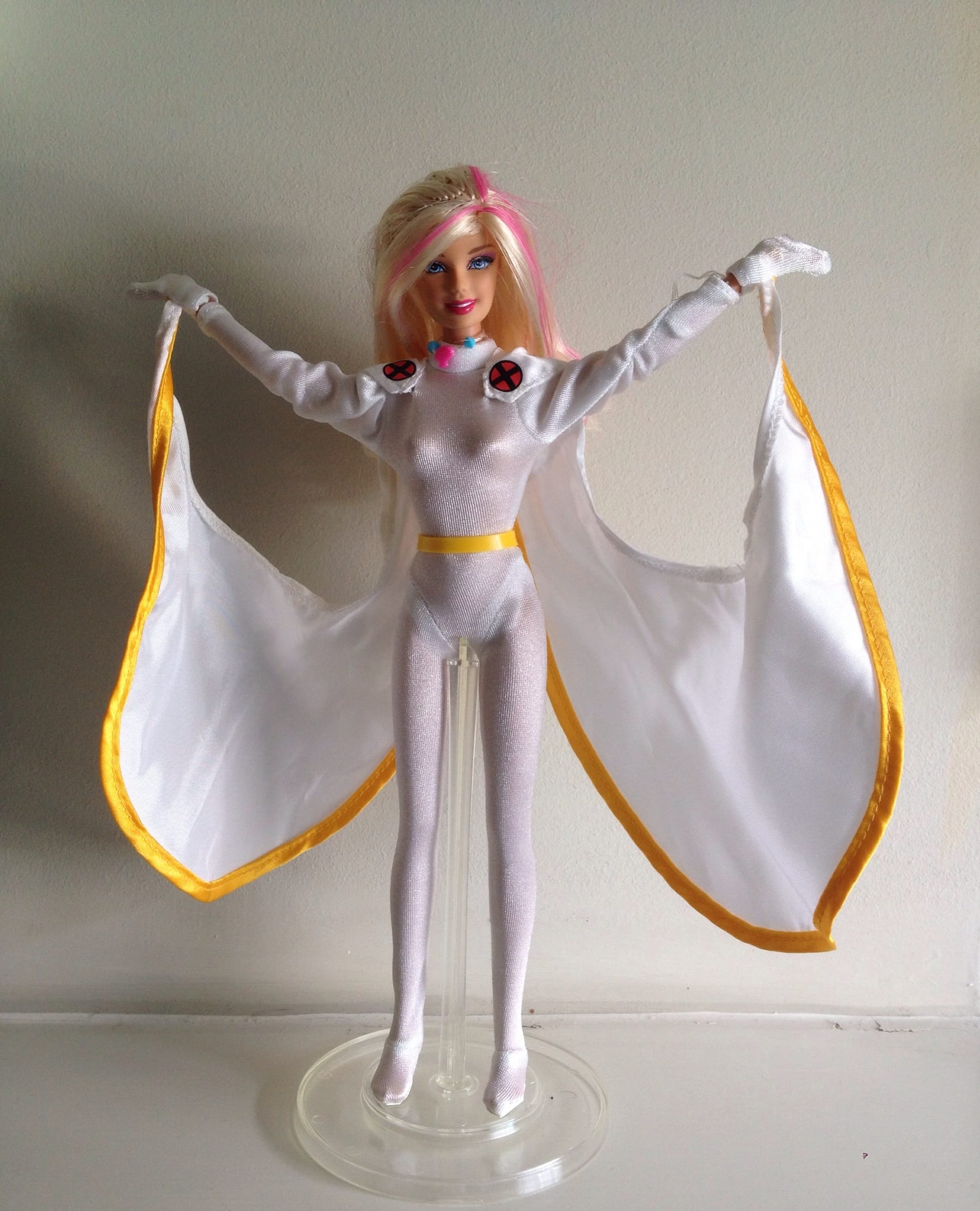
Our X-Men Barbie: If she was an actual toy (as opposed to Beach Barbie wearing a Storm circa ’96 outfit), would she be categorised as a boy’s or girl’s one?
If the toy industry were at all sympathetic to the issue of their gender division of toys, we wouldn’t have to keep complaining. But is it fair to criticise them?
Recently, kids brand consultant – and father of 2 girls – Steve Reece (@nevetseceer) wrote this piece on it. Let’s just say it lost me at labelling those like myself, who disagree with the gender categorisation of toys, as ‘bandwagon jumping opportunists’ – and it went downhill from there. I shared it on Twitter, tagging Steve, and he & others responded.
Rarely does anything useful or constructive result from people with entrenched opposing opinions debating online. This was no exception.
As the twitter back & forth ensued, there were many of his points I failed to adequately address or respond to. Other people, notably scholar Elizabeth Sweet, had a more meaningful contribution. Here’s my tweet, followed by a sub-edited version of the ensuing conversation.
I dare you to read this and not get annoyed. ‘Gender specific toys ain’t over yet’ http://t.co/RSbk4VRqeO by toy consultant @nevetseceer
Carrie Proctor: Does Steve Reece not see that children pick certain toys because they’re taught to do so by society?
Steve Reece: I agree with you…kids choose toys based on societal influence…majority of parents see boys & girls toys still
Carrie Proctor: That’s why we try to get toys for our daughter in bright primary colours. She’ll pick her own favourite one day. 🙂 (Favourited by SR)
Enter Dr. Elizabeth Sweet, a Postdoctoral Scholar whose current research focuses on gender and children’s toys. So far more qualified than me/most in this area.
Dr. Elizabeth Sweet: My research finds that toys are far more gender segregated and stereotyped now than ever before. Simply not true that toys have always been so gender defined nor that they have to be.
My initial tweet also provoked this response from freelance writer Lisa Granshaw.
(ICYMI – Steve’s hashtag reads: Reflecting current reality, not saying it should be that way, just that it is)
Elizabeth Sweet initially responded (before I butted in).
Elizabeth Sweet: Actually, not a reflection of current reality if you look at demographic & attitudinal measures in re: to gender. I would revise this piece I wrote in 2012 to say that gendering today is far more extreme than in ’50s.
Steve Reece: Really…? Difference between what people say hypothetically versus Behaviour measured by what sells…?
Elizabeth Sweet: When you only offer people one choice (e.g. highly gendered toys), is it surprising that they choose it?
Me: (To Steve) Chicken/Egg. They buy what you sell. I’d buy more female Star Wars & superhero toys if sold.
Steve Reece: You may buy, but are there enough like minded to justify tooling etc? Toy companies supply to demand.
Me: How do you know girls won’t buy/play Star Wars/Marvel, when they’re labeled as ‘boys’ brands?
Elizabeth Sweet: Toy companies are actively shaping demand by offering few and narrow choices vs. responding to it.
Steve Reece: Are there no female characters in those films? Male character sell by far most toys…
Me: Black Widow practically airbrushed from most Avengers merchandise; same with Leia and Star Wars. And both clearly defined as ‘boys’ brands by licensees and retailers, therefore excluding girls
Steve Reece: Commercial reality = if paying major license fees toy companies want every product that will sell.
Me: In the meantime, risk averse toy companies are excluding girls. Where’s the child development in that?
Steve Reece: Hard to stay in biz if don’t sell products made…no child development then?
Me: ICYMI – “Opportunist commentators have jumped on this bandwagon to blow their own trumpets, and… advance their own ends.” Nice Steve Reece.
Steve Reece: Demonising toy industry which positively contributes to development of billions of kids globally, for supplying demand. Also nice.
Me: What’s positive for girls who think science sets, doctors kits, or toolboxes are for boys – because they’re not pink? Not just toy industry – clothes, books, magazines, it’s a problem with most things being sold to kids.
Me: (to Steve) I will never buy into your argument that sexism is justified to sell toys. Is racism too? The removal of Gamora from so much Guardians of the Galaxy merchandise is appalling. But you think that’s ok?
And there the conversation ended, and I’m glad it did as there was nowhere new I was able to take it.
Pretty depressing.
If this is the attitude of the toy biz then we have a long way to go, no matter what lip service they pay to our issues with their gender categorisation, and screening of licensed characters by gender – such as the aforementioned cases of Princess Leia, Black Widow, and Gamora being absent from a large chunk of movie tie-ins.
The citing of market research and of responding to consumer demand – without acknowledging the industry’s role in skewing those results through their marketing, or creating that demand – is frustrating.
These companies choose to create products for children, which as far as I’m concerned means they have a responsibility to not only make a profit, but – at the very least – to not negatively impact our children’s lives. It’s not much to ask, and the two things are not mutually exclusive.
And frankly, the notion that the likes of Hasbro, Mattel, or Disney might go out of business if they and retailers sorted and labelled toys by type or function instead of gender, is laughable.
But these industry behemoths do need to evolve their offering, for their own sake. Take Barbie, the queen of the pink aisle. Her global sales have significantly dropped in four of the last five quarters, and for an even longer period in the US (about 2 years). Some of Mattel’s initiatives, like the Barbie Project are interesting. Others, like putting her on the cover of a Sports Illustrated Swimsuit Edition, are troubling.
However, if the choice really is as Steve Reece claims, between these companies survival or our children’s positive development, then I’ll happily wave bye bye to Optimus, Mickey, and Barbie.
The toy industry’s ability to generate profit does not supersede our children’s rights to grow up without having profit-motivated limits placed on their imaginations, aspirations, and ambitions. But there is no reason the removal of these limits and the industry’s profits cannot happily co-exist. If anything, it will become necessary for both parties to flourish.
===============
Oh, for another perspective on this issue, please read this excellent post from someone who is at the frontline of all this – working at a toy shop! His point is a very perceptive one that has lead me to question how I would shop as a parent in this situation.
If Marvel can turn their obscure cosmic superteam into a must-see movie, then there’s no excuse for them not to break the mould again to finally give us a great female superhero movie.
Guardians of the Galaxy, adapted by Marvel from their post-millennial revamp of their 60’s cosmic superteam, has opened to glowing reviews, a $160 worldwide weekend box office gross, and delighted audiences (including this excited English at-home dad). It featured a couple of strong female roles, and while the lack of damsels in distress is great, we need more than empowered women in these flicks – we need female protagonists.
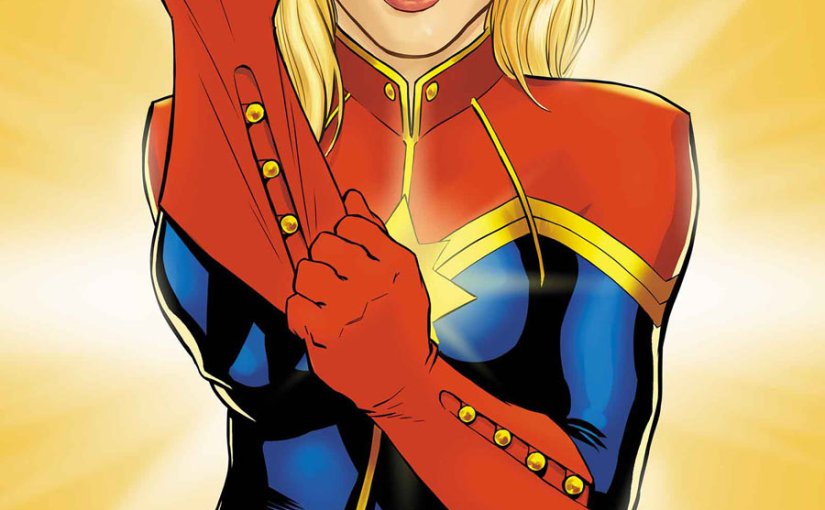
Well, are we seeing the beginning of that? The most likely candidate for a movie has long been mooted to be another cosmic character – Captain Carol Danvers, the former Ms. Marvel, who like the galactic guardians also had a successful makeover and relaunch in the comics – and is now Captain Marvel. But who could play the smart, confident, kick ass blonde space captain? Many names have been bandied about over the past few years, with a few firm favourites.
Joss Whedon, Avengers director and the self proclaimed Tom Hagen of the Marvel cinematic universe, offered a great hint recently, in response to the recent publicity stunt news that Thor was going to become a woman in the comics.
ICYMI, that’s Katee Sackhoff as ‘Captain’ Starbuck from the revamped version of Battlestar Galactica, of which Whedon is a big fan. Frankly, she would be awesome casting, and would likely get everyone from feminists to misanthropic geeks onside.
Well just to add to the intrigue, Sackhoff herself posted the following cryptic tweets over the weekend.
Headed out for day one of a super secret job….I will send photo clues throughout the next 3 days! Clue #1 pic.twitter.com/1mVRmQKNmE
Even by the time I hit ‘publish’ this will probably be debunked. But #1 could be a face casting for a mask; #2 a close up detail of her red & gold costume, and #3 – a veil = Mar-VEL?!
Clutching at straws? Probably (yes). But we need really a decent female superhero movie, so I am latching on to any nuggets of hope that I can. Selfishly speaking, I need a decent female superhero movie in the next few years. My daughter is 2 1/2. By the time she is 8, I want to be able to take her to see an awesome superhero flick with a fantastic female protagonist.
5 years ago, I would NEVER have predicted there would be a Guardians of the Galaxy movie, much less one as faithful yet mass market as this one. I hope that within 5 years Marvel can do something far less bold – female led fantasy movies are doing great box office – yet far more important.
And in case you’re in any doubt, here’s how awesome Katee Sackhoff would look as Captain Marvel.
Calling myself a stay-at-home dad is a bit disingenuous. We rarely stay at home, especially when the weather is this good. Today we pay a typical mid-week, mid-morning visit to our nearby playground to meet some friends for a playdate.
We arrive before them. I ask my daughter what she’d like to go on. As she considers her answer (she’s a bit of a ponderer), a mother ushers her crying child past us. “I’ll go and see if anyone has any plasters.”
I call out to her to say I have plasters if she needs any. She enthusiastically answers yes, and she comes over with her crying daughter who has a pair of grazed knees. I tell them I hope Spider-Man ones are ok, and the mother tells her how lucky she is the nice man helped us, and that her brother will be so jealous of the plasters (he comes over and does indeed look on jealously).
With great plasters comes great responsibility.
I notice the girl has a snotty nose, the kind that often accompanies such bouts of crying. I offer a tissue. The mother’s eyes widen, and she tells me & her daughter how amazing I am, how great the Spider-Man plasters are, and again how lucky they are the nice man was here – because mummy forgot to bring anything.
The mother laughs when I compare my daughter’s nappy bag to a secret agents ‘go bag’, that’s always packed with necessities so we can just grab it on the way out. Plasters applied, nose wiped, the mother thanks me again and wishes us a great summer.
Warning! Stranger danger!
Moments later, I am cleaning something unsavoury from the bottom of my daughters shoe. A little girl comes up to us, intrigued about what I’m doing. Aged about 3 or 4, the girl starts asking me questions, such as what’s that picture on my daughter’s shoes “Turtles.” I reply. “Teenage Mutant Ninja Turtles.”
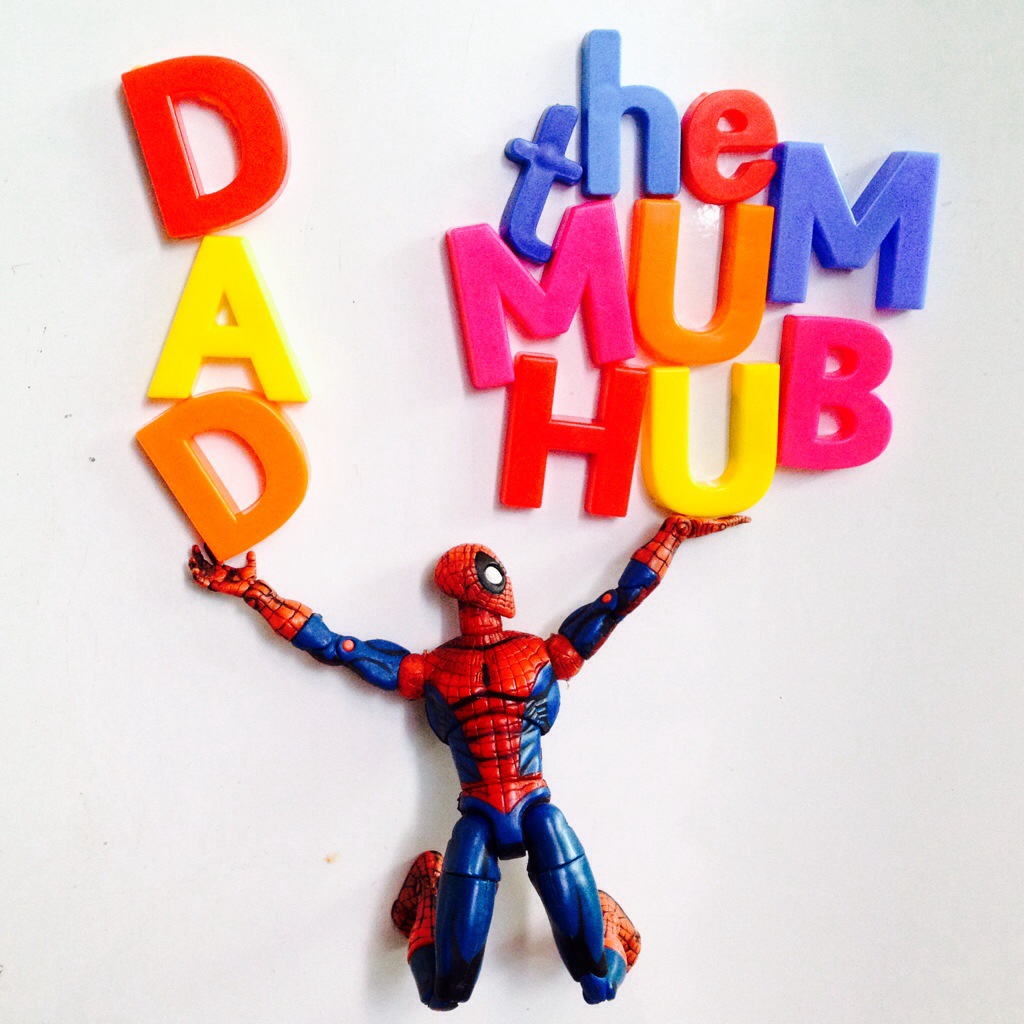
It was a nice conversation. Suddenly, her mother strides over and pulls the girl away from us without looking at me or saying anything until they stop beneath a nearby tree, where the little girl is admonished for talking to a “strange man”. The girl looks perplexed. Her mother then drags her back to a huddle of other parents in the centre of the playground – a collective I call the mum-hub.
This is a place where stay-at-home dads fear to tread
This is an elusive and distant group. I have never been invited into its confines. The other week, I spotted a mum who I had met before, who I had been chatting to at a pre-school visit we had both attended, whom I had since exchanged hellos with on the street and in the supermarket. She seemed nice, and I was looking forward to chatting to her again. I made eye contact and smiled, hoping to get at least a smile in return, and she immediately looked away. She spent the afternoon laughing enthusiastically with her fellow mum-hubbers, ignoring me even when nearby.
I have never seen any dads in the mum-hub. Not even partners. The mum-hub is usually a child-free zone too, a place of adult conversation while their children fend for themselves – laughing, playing, fighting, falling, getting stuck, getting bullied, crying. Today, there was lots of crying and distressed pre-school children that needed the attention of strangers before their parent in the hub noticed. Yet, the reaction was swift when a little girl decided to talk to me, the strange man.
None of the other mums I know – actually know as opposed to one I chatted to once – are ever in the hub either, nor was the friendly mother who I offered the Spider-Man plasters to. I can only assume they think nothing of a dad playing with his daughter.
Perhaps the mum-hub is in my imagination, but it represents those collections of mothers that are off limits to at-home dads like me. They exist in playgrounds, playgroups, and cafes. They are cliques of (usually) at-home mums whose exclusively female daytime community is by design not accident, that prefer their women only social-parenting life. Who find it odd that a man might want to be at home with their children, perhaps even suspicious. Mothers like Loose Women’s Nadia Sawalha, who stated “I don’t really want to talk to them. I don’t want them to be there.”
I obviously find it sad that this is the case. I’m not going to confront them about it. There’s a bit of live and let live, but mainly because it’s pretty ugly in front of children.
What I can do is continue to be the engaged stay-at-home dad I am, take my daughter to the playground, and hopefully little girls will see that there is nothing weird, or anything to be afraid of, about a man accompanying his child there. I also hope all kids will see there’s nothing weird about a girl wearing Spider-Man plasters or Ninja Turtle shoes.
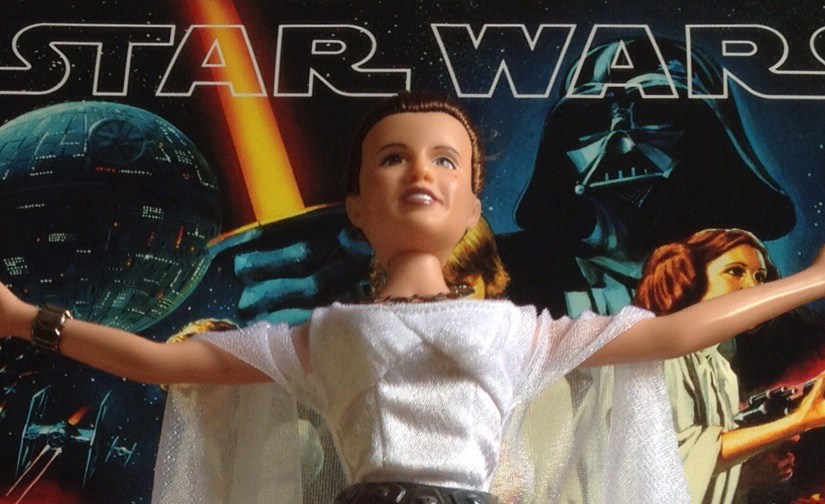
My daughter giving her Hasbro Leia doll (courtesy Emily) a blow-dry
Hasbro, the primary Star Wars toys licensee, has a brand developer vacancy for their Star Wars line.
Like Disney, they still see Star Wars as a boys brand – but using Hasbro’s job ad as a guide, here are 7 ways the new Brand Manager can impress their new employer by improving sales, decreasing costs, and ultimately raising profits – as well as addressing the gendered marketing issue.
In fact, it’s the solution:
The primary Duties & Responsibilities of the Star Wars Brand Development role:
1. Finding innovative ways to grow higher margin businesses. A: An innovative way to grow higher margin businesses would focus on marketing Star Wars to girls as well as boys. This will increase sales with minimal additional costs.
2. Drive product innovations to better meet consumer demands. A: Innovate by creating Star Wars products with girls in mind, meeting their additional consumer demand. Also market the entire brand to both girls and boys – girls will also buy existing products that are currently (but erroneously) deemed as ‘boys’ toys, and boys will purchase many products you might think of as being for ‘girls’.
3. Develop overall go-to-market product strategy. A: The strategy needs to focus on the fact that Star Wars is a brand that appeals to both boys and girls, as well as their Star Wars fan parents. Create product for, and market the brand to all of them.
4. Find ways to decrease development costs and gain efficiencies. Decrease development costs by marketing current products to girls as well as boys. Efficiencies would be gained by selling an already existing product to a new market with minimal additional cost.
5. Keep up to date on modern manufacturing trends, technologies and competitive practices. A: Be competitive – and modern – by marketing Star Wars to girls as well as boys.
6. Work with global brand strategy & marketing team to develop special and exclusive products. A: The global brand strategy for the development of all special and exclusive products must include marketing the Star Wars brand to girls as well as boys, to increase sales.
7. Become the global insights expert and leverage learning across product lines. A: An insight that Hasbro must learn – the Star Wars brand is in an almost unique position as, despite Hasbro’s insistence that it’s a ‘boys’ brand, it actually appeals to girls too. Additional product made with girls in mind can certainly be produced, but the overall brand is unisex. In addition, today’s parents would have grown up with Star Wars, back when it had overt cross gender appeal, so parents of boys and/or girls will be be primed to purchase product for the daughters as well as their sons. Hasbro should be including, rather than excluding girls from the Star wars brand, as it will lead to increased sales for the entire line.
OK, it’s not really 7 ways – they all have basically the same answer: Girls.
‘I am the way’
But you have to admit, the plan has a singular clarity to it.
The successful applicant can now arrive as saviour, with a bold game changing strategy that benefits all.
Or to put it another way, the Chosen One can finally fulfil the prophecy of bringing (gender) balance to the Force.
If you know a little bit about comics, you probably think that Bob Kane created Batman. In fact if you know a lot about comics you still might think he created Batman. That’s exactly what Bob Kane always wanted you to think. But Bob Kane lived in the Batcave that Bill Finger built.
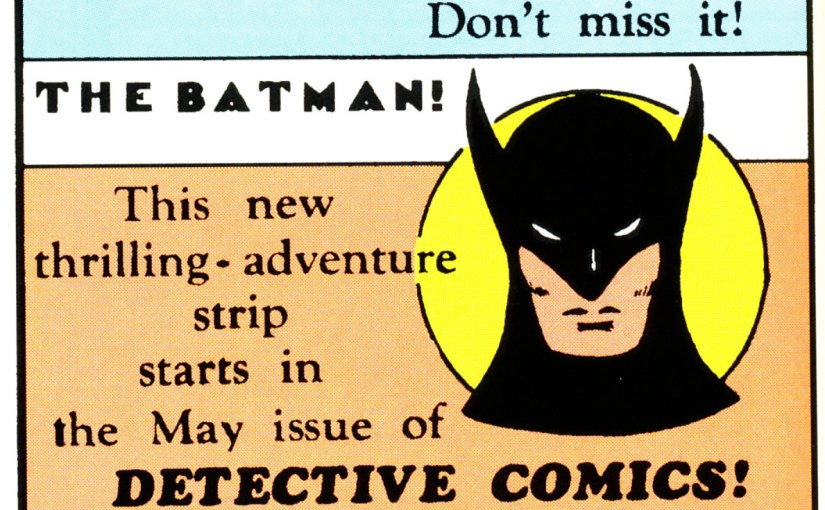
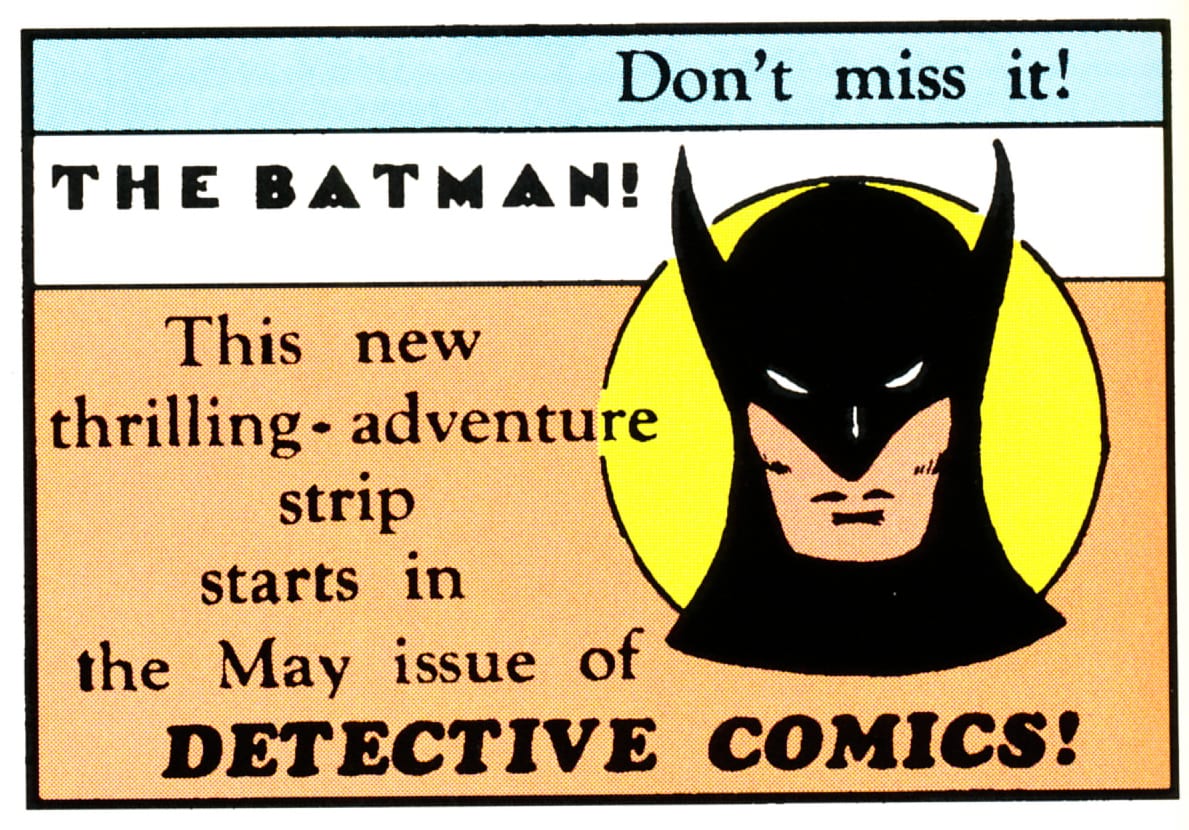
Today has been designated by DC Comics as Batman Day, in honour of the 75 years that have passed since the debut of the Dark Knight in Detective Comics no. 27.
On a Friday sometime prior to that 1939 comic hitting the stands, Kane had promised his publisher a great new character by Monday. In his struggle for an idea, he came up with ‘Bird-Man’, a masked Flash Gordon rip-off with wings. Kane had the good sense to show his work in progress to his friend – a writer named Bill Finger, who set about creating a better character instead.
Basically, almost everything that is iconic and cool about Batman, Finger came up with – his outfit, his origin, his alter-ego, his lack of superpowers, being a detective, the Batmobile, Gotham City, and even (in collaboration) supporting characters like Robin, Catwoman, Riddler, and the Joker.
“Criminals are a superstitious cowardly lot,” – Bill Finger, Detective Comics (1939)
It was an instant hit. What followed for Kane was a career of taking credit for Finger’s and then others work, and being paid handsomely for it. The writers and artists got what Kane considered a fair page rate, but far less than he was paid by the publisher and with no credit or royalties. As a businessman, you have to admire Bob Kane – in the way you might admire Donald Trump or Tony Montana.
Despite the fact that this all is common knowledge in the comics industry, DC cannot name Finger as co-creator of Batman for legal reasons. The rumour is that Kane pretended he signed his original contract as a minor (which would’ve been illegal), and blackmailed DC precursor National into a new contract naming Kane as the sole creator of Batman, in perpetuity.
If it wasn’t for Bill Finger, today wouldn’t be Batman Day, but ‘Bird-Man’ Day. No, scratch that. Kane’s Bird-Man would have obviously faded into obscurity as the highly derivative creation it was. But here we are 75 years later – on Batman Day.
Like many of his peers, Bill Finger’s comic book career consisted mostly of anonymous writing for a basic page rate. He passed away 40 years ago in 1974. Bob Kane survived him a further 24 years until 1998. But in death, Bob did acknowledge a co-creator for Batman on his headstone – but sadly, it’s not who you think…
Yup – God. As co-creators go, you could do a lot worse than THE creator I guess. God was not available for comment.
As mentioned, DC cannot actually name Bill Finger as a Batman creator, but they have done the best they can – crediting him as the writer of Detective Comics no.27, the first appearance of The Bat-Man, on the cover of DC’s 75th anniversary edition of the issue, available as a free comic book today.
Despite my love of superheroes, I’m not one to advocate violence because a) it’s usually wrong, and b) I’m a coward. But I can’t help thinking about the following tale that famed comicbook artist & writer Jim Steranko told his followers on Twitter last year.
So, as well as remembering Bill Finger, the man who basically created the Caped Crusader as we know him today, you can also celebrate Batman Day by reliving the time Jim Steranko bat-slapped Bob Kane 🙂
Bob Kane – you’ve been Steranko’d!
Jim Steranko
“I hadn’t encountered Kane in my travels, but at one rockin’ SDCC (San Diego Comic-Con), an associate asked me if I wanted to meet him, and walked me into a hallway.
There he was, in a small group of people, wearing patent-leather shoes– and an ASCOT, like he was Vitamin f******g Flintheart in a Dick Tracy cartoon.
For years, I’d heard how he’d taken credit for Bill Finger’s contributions (in addition to half his pay) and other despicable tales from his associates. But nothing aces an in-person encounter.
We were introduced and Kane began talking about my Batman chapter in the HISTORY OF COMICS, which treated him–and everyone else–very respectfully. He felt I credited Robinson & Finger (both of whom I knew intimately) too much. Kane (aka Kahn) was beyond pretentious, an intolerable ass as pompous as they come. I bit my tongue while he regaled us with his many achievements.
The group was waiting for an elevator, which they stepped into when the door opened. Our conversation ended, but not before he said: “See you later, Jim, baby,”and cuffed me across the face–like some rat-pack street gesture he’d seen in some cheap flick. The doors closed…I was stunned by the sheer audacity of a stranger–like him–to lay a hand on me, and boiling with anger.
That night, I couldn’t sleep and the next morning began combing the halls for his Bat Majesty. Around noon, I found him in another group, which I walked into. “Good to see you, Bob, baby!” I said, then bitchbat-slapped him across the face.
But this time, there was no elevator door closing between us. I stood there for about 15 seconds, waiting. He did nothing. I turned and left. But I regret it now. I regret that he didn’t do anything about it, even though he was at least a head taller than me. I wouldn’t have minded bleeding at all for one more opportunity to give Kane the kind of Bat Lesson that Finger, Robinson, Sprang and others only dreamed of.
Finger was THE creative force behind Batman.
ALL the cool Bat elements are his concepts.”
(Thanks to Rob Duncan for the Steranko bat-slap Storify, and no thanks to WordPress for the inability to embed it in this post!)
My daughter giving her Hasbro Leia doll a blow-dry
Not only does the Disney Store have Star Wars pigeon-holed as a boys only brand, it seems that main toy licensee Hasbro does too.
In this job ad (courtesy of Natalie Wreyford and ta-dala), Hasbro states it has “immediate need for a detail-oriented, brand developer… for Star Wars” their “Boys Licensed brand”.
Sigh.
The ad lists seven key aspects of the job, but reading them it seems to me that a plucky applicant could successfully address each of these bullet points by addressing the gendered marketing issue too.
So, if you’re a detail-oriented, brand developer candidate – who is “proactive”, “responsive”, “creative”, and with “analytic based judgement” – looking to make a name for yourself, you could try this approach. I am after all a marketing guru (:s).
Primary Duties & Responsibilities of Star Wars Brand Development role:
1. Lead cross-functional teams to execute key brand initiatives, including finding innovative ways to grow higher margin businesses. A: An innovative way to grow higher margin businesses should involve marketing Star Wars to girls as well as boys.
2. Drive product innovations through the system to better meet consumer demands. A: Innovate by creating Star Wars products intended for girls, meeting their additional consumer demand, and market the entire brand to both girls and boys.
3. Develop overall go-to-market product strategy. A: Create product and market the whole brand to both boys and girls.
4. Partner with global supply chain to identify programs to decrease development costs and gain efficiencies where applicable. A: Market existing products to girls as well as boys. Efficiencies gained by selling an existing product to a new market with minimal cost.
5. Maintain current knowledge of modern manufacturing trends, technologies and competitive practices. A: Be competitive by marketing Star Wars to girls as well as boys.
6. Collaborate with global brand strategy and marketing team in the development of all special and exclusive products. A: Suggest the global brand strategy includes marketing Star Wars brand to girls as well as boys.
7. Become the global insights expert and leverage learning across product lines. A: Your insight should involve the need for marketing Star Wars to girls as well as boys. If not, this should be learned.
So there you go. You’ve got that application nailed! Why not apply using this as your template? If you can’t beat them, join them. Then beat them.
Failing that, tweet them at @HasbroNews, or email them at hasbrobrandpr@hasbro.com, and let them know that Star Wars is a galaxy for girls too – because they obviously didn’t get the #WeWantLeia memo.






 Guardians of the Galaxy, adapted by Marvel from their post-millennial revamp of their 60’s cosmic superteam, has opened to glowing reviews, a $160 worldwide weekend box office gross, and delighted audiences (including this excited English at-home dad). It featured a couple of strong female roles, and while the lack of damsels in distress is great, we need more than empowered women in these flicks – we need female protagonists.




 On a Friday sometime prior to that 1939 comic hitting the stands, Kane had promised his publisher a great new character by Monday. In his struggle for an idea, he came up with ‘Bird-Man’, a masked Flash Gordon rip-off with wings. Kane had the good sense to show his work in progress to his friend – a writer named Bill Finger, who set about creating a better character instead.


 Man vs. Pink